
Prestudy case study
Finding buried offshore wind power cables with AUV magnetometry.
A three-axis fluxgate magnetometer with a 0.5 nT/√Hz noise floor can plausibly detect the grid-frequency magnetic signature of buried subsea power cables. The strongest near-term claim is cable detection and route positioning; burial-depth estimation is possible only as an effective magnetic source-depth estimate unless the cable model is constrained.
Scenario
One export circuit is already a meaningful target.
The baseline model uses a 220 kV HVAC export cable carrying 300 MW, buried 1.5 m below the seabed. That is representative of a mid-scale wind farm, or one ordinary export circuit in a larger project.[1][2][3]
The inter-array comparison uses a 66 kV cable carrying a modelled 50 MW mid-string load, roughly equivalent to three large offshore turbines. The source basis is the 66 kV string architecture and 15 MW turbine framing, not a stated 50 MW cable rating.[4]
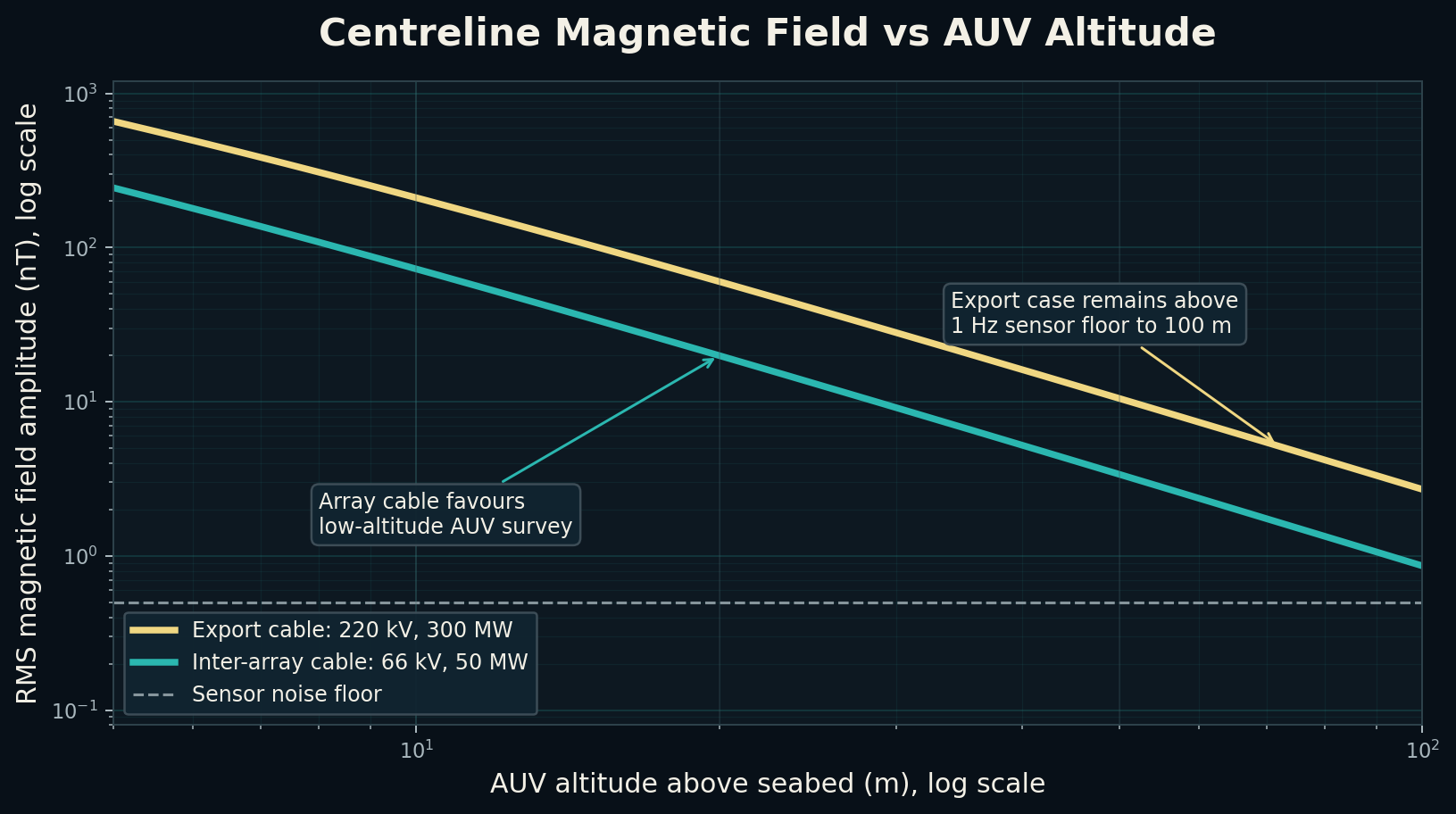
Both scenarios are considered detectable at low AUV altitudes, with the export cable showing the greatest potential; robust burial-depth estimation is the harder part.
Detection level
Export cables produce a surveyable anomaly in the screening model.
In the straight-conductor screening model, the 300 MW export cable gives about 659 nT at 5 m altitude, 210 nT at 10 m, 60 nT at 20 m, and 10.5 nT at 50 m. The modelled 50 MW inter-array section gives about 244 nT at 5 m, 73 nT at 10 m, and 20 nT at 20 m.
Measured offshore-wind examples sit in the same order of magnitude. OFG's MARELEC 2023 case study shows 50 Hz export-cable crossing amplitudes of a few hundred nT, inter-array responses that are smaller but still clear, and wind-farm-loop peaks approaching roughly 600 nT in the plotted survey example.[5]
Helical core lay and sheath/armour currents can strongly change the residual external field. The straight model is therefore an upper-bound screening case, not a final cable-physics claim.[6][7]
AUV survey
A single magnetometer can map the cable trace.
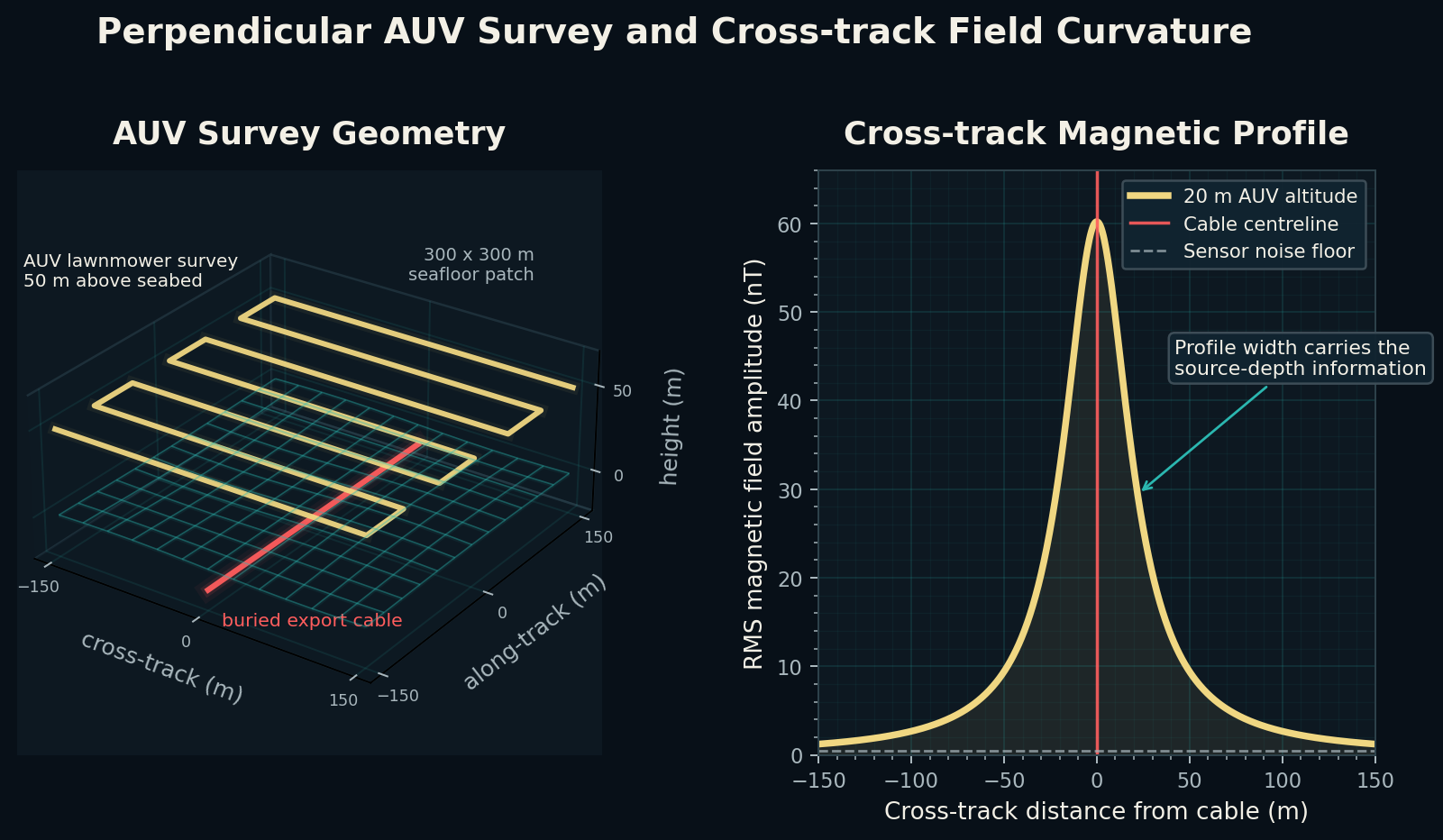
With near-perpendicular transects over a 300 m corridor, a single AUV magnetometer can locate the horizontal cable trace if the cable produces a measurable residual field. Line spacings of 25-50 m give useful repeat crossings and route confidence; 100 m is workable for a straight route; 250 m is sparse.
The cross-track anomaly shape is the useful information. Lower altitude gives a sharper peak and better localization. At 50 m altitude the anomaly is broad and burial-depth sensitivity becomes weak.
Burial depth
Curvature helps, but the source model still limits accuracy.
Magnetic field curvature can estimate an effective magnetic source depth because the profile width encodes total distance from sensor to source. In the straight model, the profile half-width is close to AUV altitude plus burial depth.
That is promising at 5-10 m altitude and potentially useful around 20 m with repeat transects. It is not robust at 50 m. More importantly, true burial depth remains model-limited: helical lay, phase imbalance, sheath bonding, armour currents and cable construction can mimic burial-depth changes.[6][8]
Technology fit
Dual magnetometers are a strong enhancement, not a model substitute.
A second synchronized magnetometer adds a simultaneous gradient/range proxy, improves confidence in cable detection, helps reject common-mode background fields, and reduces amplitude-versus-distance ambiguity. It significantly improves the survey product when the cable residual-field model is valid.
It does not, by itself, solve burial-depth estimation. The defensible claim is cable detection, cable tracking, and effective source-depth estimation. True burial depth requires constrained cable data, calibrated residual-field behaviour, and accurate AUV altitude.
Discuss AUV integrationReferences
Source basis.
- Guide to an Offshore Wind Farm: Export cable. Used for the 220 kV HVAC export-cable framing and about 300 MW per three-core subsea export cable.
- Guide to an Offshore Wind Farm: Cable burial. Used for typical offshore wind cable burial depths of about 1-4 m below seabed.
- IRENA: Renewable Power Generation Costs in 2024. Used for offshore wind project-scale context, including average project capacities commissioned in 2024.
- Building Offshore Wind in Ireland: Array cables. Used for inter-array cable context, including 66 kV array systems, string topology and 15 MW turbine framing. The 50 MW case in this prestudy is a modelling assumption for a mid-string section, not a value directly stated by this source.
- OFG at MARELEC 2023: HyperMag cable-mapping case study slides. Used for measured 50 Hz magnetic-field examples from export and inter-array offshore-wind cable crossings, especially slides 13, 15 and 17.
- del-Pino-Lopez, Cruz-Romero and Bravo-Rodriguez: 3D FEM modelling of three-core armoured submarine cables. Used for the caution that 2D approaches can overestimate magnetic fields when conductor and armour twisting are omitted.
- Benato et al.: Core laying pitch-long 3D FEM model. Used for metre-scale core lay-pitch context and the modelling challenge of full three-core cable geometry.
- Impact of solenoid effects on series impedance of three-core armoured cables. Used for additional context on twisted cores, armour lay and cable-construction effects.